
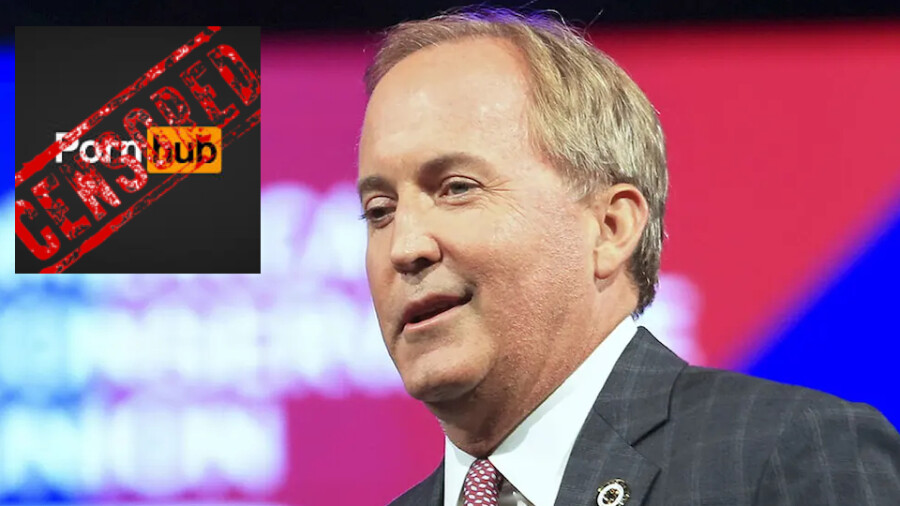
AUSTIN — Texas’ Republican Attorney General Ken Paxton filed a lawsuit Monday against Aylo, alleging the company is in violation of the state’s controversial age verification law, which mandates adult websites must post a health warning repeating religious anti-porn propaganda myths.
The law is currently being challenged on constitutional grounds.
Paxton posted on his X account an alarm emoji followed by, “Today, I filed a lawsuit against Aylo Global Entertainment, a major pornography distribution company, for violating HB 1181, a Texas law that requires reasonable age verification measures to protect minors from being exposed to obscene materials.”
Texas, the AG continued, “has a right to protect its children from the detrimental effects of pornographic content. I look forward to holding any company accountable that violates our age verification laws intended to prevent minors from being exposed to harmful, obscene material on the internet.”
Industry attorney Corey Silverstein of Silverstein Legal told XBIZ, “This is both a disturbing and distressing turn of events. The audacity for the state of Texas to proceed with this case while the court of appeals is weighing the unconstitutionality of this law is an absolute shame.”
Silverstein added he considers it likely that Aylo will file for the lawsuit to be moved to a federal forum instead of Paxton’s chosen venue, a district court in Texas’ Travis County.
Paxton Doubles Down on Compelled Speech
Paxton’s filing specifically foregrounds that HB 1181 “requires websites to warn of the harms associated with viewing such material, including potential addiction, impaired brain development and function, and other emotional and mental illnesses.”
As XBIZ reported, the law refers to those mandatory statements as health warnings, although Texas Health Authorities have refused to comment on whether they believe these propaganda points and largely debunked pseudo-scientific theories have any factual backing.
Last August, XBIZ asked the Press Office of the Texas Department of Health and Human Services if the department could provide any documentation or statement pertaining to those warnings, and clarify whether the language of the warnings has its basis in any documentation or statement produced by the Texas Department of Health and Human Services.
After requesting several days to provide a reply to the query, Press Officer Tiffany Young declined to answer, deflecting the questions with an invitation to contact “the authors of this bill for information about how it originated.”
XBIZ also contacted Texas Department of Health and Human Services Chief of Staff Kate Hendrix and the bill’s main sponsor, Rep. Matt Shaheen (R), but received no reply to the same questions.
HB 1181 was passed by the Texas legislature in May 2023, including the mandatory pseudoscientific anti-porn propaganda disclaimers declaring that “pornography is potentially biologically addictive, is proven to harm human brain development, desensitizes brain reward circuits, increases conditioned responses and weakens brain function.”
The compelled speech statements must be posted “in 14-point font or larger” on adult sites’ landing pages as well as on any advertisements for adult sites.
The websites are also compelled by the state to post the phone number of the U.S. Substance Abuse and Mental Health Services Administration’s helpline.
A Controversial Law Already Being Challenged
HB 1181 is a much-augmented version of Louisiana’s age verification law and its many copycats, and echoes the debunked “porn addiction” language of faith-based anti-porn groups. It was spearheaded by religious Republicans but was supported by almost every single Democratic state legislator.
At the time Texas’s Republican Gov. Greg Abbott signed it into law, Free Speech Coalition (FSC) condemned the Texas law — along with similar laws recently passed in Louisiana, Utah, Virginia, Mississippi, Arkansas and Montana — as “blatantly unconstitutional” and a “violation of the First Amendment rights of creators, consumers and platforms.”
In August, FSC filed a legal challenge in Texas over HB 1181.
“Texas is not only forcing sites to put their visitors’ privacy at risk,” FSC’s Director Alison Boden wrote at the time. “They are forcing them to broadcast misinformation and pseudoscience about sex and sexuality. We are standing up not only for the rights of adult businesses and creators, but for the rights of adult Texans to access legal content in the privacy of their own home, without having to submit to surveillance or propaganda. We can all work to keep minors from accessing adult content, but allowing the government to dictate what information adults can see is unconscionable and unconstitutional.”
Joining Free FSC as co-plaintiffs were an array of adult platforms and workers, including MG Premium LTD; MG Freesites LTD (now Aylo companies); Webgroup Czech Republic, A.S.; NKL Associates, S.R.O.; Sonesta Technologies, S.R.O.; Sonesta Media, S.R.O.; Yellow Production S.R.O.; Paper Street Media, LLC; Neptune Media, LLC; Mediame SRL; Midus Holdings, INC.; and Jane Doe, an adult content creator.
Issues around the constitutional challenge are still being argued at the Fifth Circuit Court of Appeals.
Paxton missed the earlier part of that litigation because he was being impeached by a bipartisan coalition in the Texas Legislature over corruption and had temporarily been replaced as AG. He was later acquitted after his impeachment trial when several of the Republicans who had voted to impeach him changed their mind and voted in his favor.