
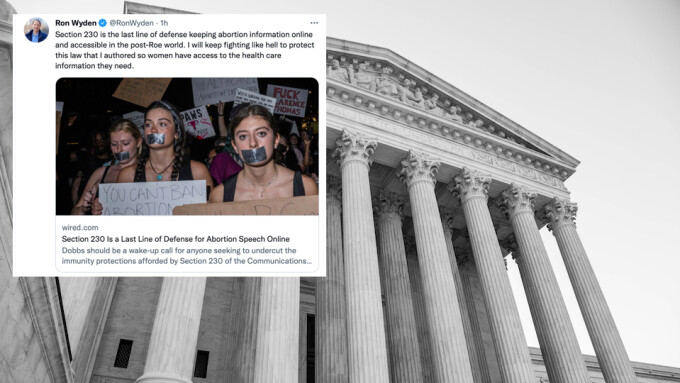
WASHINGTON — In response to a Wired article published today warning that Section 230 is a “last line of defense for abortion speech online,” the law’s co-writer Sen. Ron Wyden (D-Oregon) vowed to “keep fighting like hell” to protect it.
Repeating the headline of the Wired piece, which emphasizes the centrality of Section 230 as “the First Amendment of the internet” and a bulwark against attacks on free speech, Wyden tweeted that “Section 230 is the last line of defense keeping abortion information online and accessible in the post-Roe world.
“I will keep fighting like hell to protect this law that I authored so women have access to the health care information they need,” Wyden added.
The Wired article shared by Wyden was co-written by Evan Greer and Lia Holland of nonprofit advocacy group Fight for the Future.
Greer and Holland point out that a large number of Wyden’s fellow Democrats — among them some of the most powerful, including the President and the Vice President — who have been “misguidedly attacking” Section 230 of the Communications Decency Act need to “wake up now.”
If they “don’t start listening to the warnings of human rights experts, sex workers, LGBTQ+ folks and reproductive rights groups,” Greer and Holland wrote, “Democrats could help right-wing zealots achieve their goal: mass censorship of online content about abortion.”
Section 230, the authors opine, is “the last line of defense keeping reproductive health care support, information and fundraising online. Under Section 230, internet platforms that host and moderate user-generated content cannot generally be sued for that content. Section 230 is not absolute. It does not provide immunity if the platform develops or creates the content, and it does not provide immunity from the enforcement of federal criminal laws. But, crucially, it does protect against criminal liability from state laws.”
Section 230 is universally considered by digital rights advocates as a crucial bulwark against state and corporate censorship of controversial speech, including sexual expression and legal adult content.
To read Evan Greer and Lia Holland’s complete opinion piece, visit Wired.com.